The Callback Portfolio: A Tight Aerial Edit That Wins UK Commercial Work
There is a particular look that comes over a UK client’s face when you hand them a USB stick labelled “showreel final final v7”. It is not excitement. It is the quiet dread of someone who has twelve minutes of footage to review and a meeting at half past. Estate agents, roofers, planning consultants and event organisers do not need to see everything you have ever flown over. They need to see whether you can give them a usable image, on time, without creating a licensing headache.
That is the portfolio problem in a nutshell. Not “how do I show off my drone?”, but “how do I prove I am the sensible person to book?” A tight edit of strong, relevant frames does that far better than a sprawling collection of sunsets over a reservoir in a county nobody can quite place.
Start With the Job, Not the Drone
A common mistake is to build a portfolio around aircraft, lenses and flight modes. Clients rarely care. They care about the result: a clean elevation of a semi-detached house, a roof defect that reads clearly in a loss adjuster’s report, a site boundary that makes sense to a planner, or a crowd shot that makes an event look busy without showing anyone’s face in a way that causes bother.
So organise your portfolio by client problem, not by flight. Give each section a plain-English label: “Residential sales”, “Roof and building surveys”, “Land and planning”, “Events and venues”. Under each, put a handful of images that show the same thing done consistently well. If a picture does not help a client imagine their own job being handled, it is probably portfolio decoration rather than portfolio evidence.
Twelve Is a Feature, Not a Limit
A dozen strong frames is often enough for a commercial portfolio. Not because twelve is magic, but because it forces you to choose. If you cannot find twelve images that show range, consistency and judgement, the answer is not to pad the set with weaker work. It is to go and shoot better work.
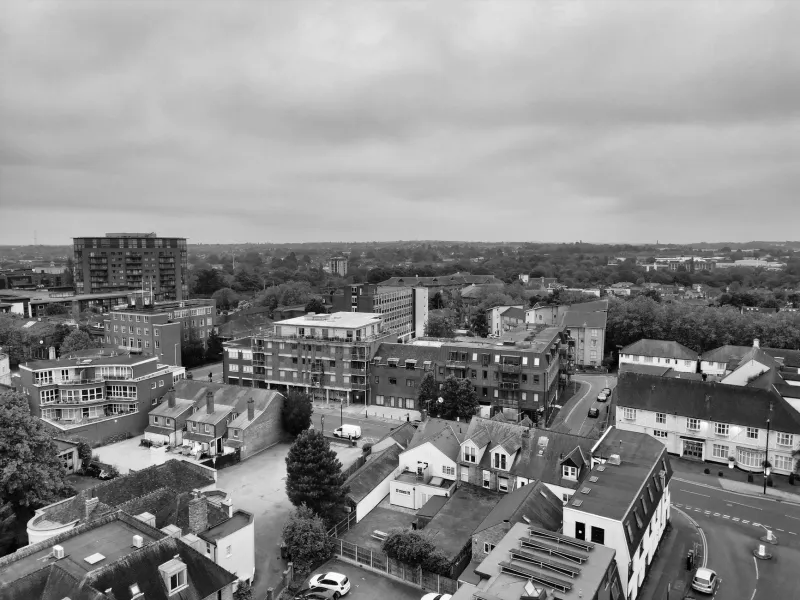
Those twelve should cover a few different jobs and a few different conditions. A bright summer roof is lovely, but UK clients know what winter looks like. Include a grey-day frame where the exposure is still clean and the detail still holds. Include a tight detail and a wider context shot. Include at least one image where you resisted the temptation to fly too high, because the client needed a readable building rather than a map with a roof in the middle of it.
For video, keep clips short. A ten-second reveal of a site is useful. A three-minute ambient drift over a housing estate is not, unless the client has specifically asked for atmosphere. Most commercial video is there to explain, not to soothe.
Grade Once, Present Consistently
Inconsistent grading is the fastest way to make a decent portfolio look amateur. One image is punchy, the next is flat, the third has a heavy blue cast because you were experimenting with a new profile in a hurry. Clients may not know why the set feels untrustworthy, but they will feel it.
Pick a simple look and stick to it. Natural colour, sensible contrast, no skies that look like a nuclear event. UK daylight is often soft and flat, and that is fine. A slightly restrained grade usually reads as professional because it lets the subject do the work. If you are showing stills and video together, make sure the video has not been graded into a different universe.
Also, crop for the client’s likely use. Estate agency portals, planning documents and social media all want different shapes. A portfolio that includes a landscape, a square and a clean vertical crop shows that you understand the job is not finished when the shutter closes.
Metadata Is Part of the Product
A good aerial image without context is just a nice picture. A good aerial image with date, location, aircraft, pilot details and a short description is a commercial asset. UK clients increasingly need to know where and when something was captured, especially if the image is going into a planning application, an insurance file or a public-facing page.
Keep a simple metadata sheet alongside your portfolio. It does not need to be fancy. Date, approximate location, purpose of flight, aircraft type, and any relevant permissions or restrictions noted at the time. If the image is going to a planner, an OS grid reference or a clear site address helps. If it is going to a roofer, note which elevation or defect is being shown. If it is going to an event organiser, note whether identifiable people are included and how you handled consent.
This is also where you separate yourself from the person who turns up, shoots, and sends a WeTransfer link with no explanation. The paperwork is not glamorous, but it is part of what the client is buying.
Licensing in Plain English
A portfolio should quietly answer the licensing question before anyone has to ask it. UK clients often want to know whether they can use the image on their website, in a brochure, in a planning submission, or in paid social advertising. If your answer is a vague “yeah, it’s fine”, you are inviting confusion.
Put a short licensing note with each case study. Something like: “Supplied for website and printed marketing use by the client. Not for resale or third-party licensing without agreement.” Then keep your actual contract separate. The portfolio note is not the contract, but it signals that you think about usage. That alone makes you easier to book.
Be careful with images that include identifiable people, private gardens, school grounds or sensitive sites. A lovely shot of a village fete is not much use if the organiser cannot use it because half the parish is recognisable and nobody agreed to anything. If in doubt, choose a different frame for the public portfolio.
Two Case Studies Beat Twenty
A short case study is worth more than a gallery of disconnected images. Pick two or three jobs and tell the story in a few lines: what the client needed, what you flew, what you supplied, and what they did with it. Keep it factual. “A roofer needed clear evidence of storm damage on a listed building. We supplied six stills and a short clip for the insurance file, with date and location metadata.” That is more persuasive than a paragraph about your artistic vision.
Case studies also give you a place to show judgement. Did you delay the flight because of wind? Did you choose a lower altitude to keep detail? Did you avoid a neighbouring property because it was not relevant to the brief? Those details make you sound like someone who can be trusted near a client’s building, not just someone who owns a drone.
The Client Test
Before you publish a portfolio, show it to someone who is not a drone pilot. Ask them one question: “If you needed this job done, would you ring me?” If they start asking what kind of drone you used, the portfolio is not doing its job. If they point at a frame and say “that is exactly what our surveyor needs”, you are closer.
A commercial aerial portfolio is not a museum of your best flights. It is a short, well-graded, properly labelled argument that you can solve a client’s problem. Twelve good frames, a clean note on usage, and two case studies will often beat a hundred pretty pictures. In the UK market, that tightness is not a limitation. It is the point.