The Booking You Have to Turn Down: Handling a Flight-Restricted Wedding Without Losing the Client
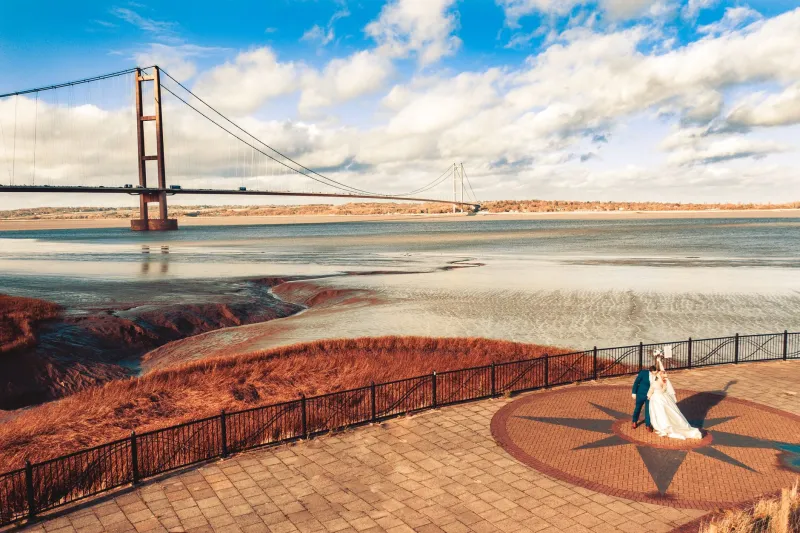
A country house hotel, a walled garden, a lake at golden hour. The enquiry lands in February for a September wedding, the venue looks superb in the brochure, and it takes about ninety seconds to discover the whole estate sits inside the flight restriction zone of a regional airport. There is no version of this job where a drone goes up.
Every UK aerial imaging operator hits this. The ones who handle it well don't lose the client — they often end up with a better booking, because the couple remember who was straight with them while three other suppliers were being vague.
Check the postcode before you check your diary
First rule: qualify the site before you quote. Ask for the full address or a what3words pin, the venue name, and the rough timings. Then run the same airspace pass you'd run for any job. A quote that has to be withdrawn three weeks later is a much bigger nuisance to the client than a question in the first reply.
For weddings, add one more check that no app will do for you: is there a major event on the same weekend? Big airshows, festivals, royal occasions and major fixtures can put temporary restricted airspace over an area that is completely clear the other fifty weekends of the year. Those restrictions are usually published well in advance, and re-checking at 72 and 24 hours is the difference between a plan and a guess.
Three kinds of no, and why the difference matters
Clients hear 'no' as one thing. It isn't, and explaining the version you're dealing with is half the job.
Absolute. Some places are simply out. Central London's protected sites, Royal Parks under their own byelaws, prison estates, sensitive military land. There is no form to fill in and no permission to chase.
Permission-based. Inside a flight restriction zone around a protected aerodrome, you can ask the operator — usually operations or the tower — and sometimes they say yes, particularly for a small, low, tightly defined flight well away from the approach path. Often they say no, especially on a Saturday in summer.
Time-based. A temporary restriction for an airshow, a marathon or a state occasion usually has defined hours. The job may be perfectly legal at 8am and impossible at 2pm.
Sorting the enquiry into one of these three tells you whether you're declining outright, applying for permission, or simply moving a start time.
Say what is true, in plain English
Please don't send the 'the CAA won't allow it' email. It tells the client nothing, it sounds like an excuse, and it's often not even accurate. Name the restriction, say where it sits relative to the venue, and say what it means for their day. Three sentences is plenty:
The venue sits inside the flight restriction zone for [aerodrome], which means drone flights need written permission from them rather than just our own checks. For a Saturday in September that's very unlikely to be granted, so we shouldn't promise aerial coverage. We can still do everything on the ground, and I'd rather tell you now than in August.
Specific, checkable, and it treats the couple like adults.
Alternatives that keep the booking
Flatly declining and walking away is the lazy option, and it usually isn't necessary.
- Ground-level filming. A gimbal on a monopod or a small slider produces genuinely lovely work: details, guests, the ceremony from the back, confetti, the couple walking out. Nobody has ever complained that a wedding film lacked a top-down shot of a car park.
- Pole or mast work. A camera on a six-metre mast, operated from the ground with the venue's blessing, gives an elevated angle without touching airspace rules. Check the venue is happy and mind the cables.
- Rooftop and balcony angles. With permission, a fixed camera high on the building or on a terrace can deliver the establishing shot the couple actually wanted.
- Move the flight, not the wedding. A nearby viewpoint, a hill, a beach fifteen minutes away for portraits the following morning. Same aircraft, same pilot, different field.
- Reschedule. An engagement shoot, a morning-after session, a first-anniversary flight over the venue when the airspace is quiet. Couples book these far more often than you'd think when you offer them.
Offer one or two of these, not all five. A wall of options reads like a sales pitch; a single sensible plan reads like a solution.
The money question
If the restriction was discoverable when you took the booking, don't keep the deposit and call it bad luck. Transfer it to the ground-level package or refund it, and say clearly which you're doing. Being scrupulously fair in the one job you can't fly is the cheapest marketing available, and it travels by word of mouth across every wedding forum in the county.
Refer, don't just regret
Keep a short list of operators who work outside the zone. A warm introduction costs you nothing and buys you two things: a favour you can call in later, and a couple who tell everyone you sorted it out.
Then follow up anyway
Diary the date. A short message a week before wishing them well, and the finished ground-level film delivered on time, does more for the relationship than any aerial clip would have. Plenty of these couples come back for anniversary shoots, or recommend you to friends marrying somewhere with far friendlier airspace.
The one thing never to do
Never launch it and hope. The chances of being caught are beside the point — the pilot who flies inside a restriction because the couple was disappointed is the pilot who eventually makes the local news, and no wedding fee is worth that. Decline clearly, offer something real, and the booking survives the restriction.